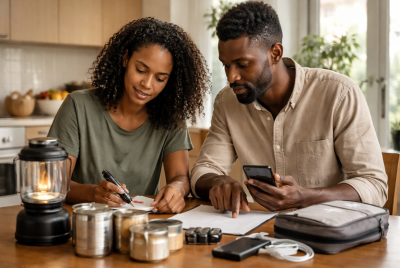
Practicing preparedness at home should make daily life feel calmer and more organized, not more complicated…
Survival Skills To Practice At Home For Beginners
Learning survival skills at home is one of the simplest ways for beginners to become more prepared without turning readiness into something extreme or intimidating. The goal is not to recreate a disaster scenario in your living room or master every emergency skill at once. It is to build calm, practical habits in a familiar environment so that, if something disruptive happens, you are more capable, less reactive, and better able to think clearly.
For most beginners, survival skills practiced at home are really about self-reliance under mild stress. They help you notice what you depend on, where your weak spots are, and how to respond more steadily when normal systems are interrupted. That could mean handling a short power outage, finding your way in the dark, cooking without your usual routine, storing water more thoughtfully, or simply staying organized when something unexpected throws off the day.
Why practicing at home makes sense for beginners
A lot of people assume survival skills belong in the wilderness, or that preparedness only becomes relevant during a major disaster. In real life, most households benefit from basic readiness long before anything dramatic happens.
Home is where most disruptions are first felt. It is where the lights go out, where the internet fails, where the kitchen stops functioning normally, where the stored supplies either help or do not, and where stress levels rise quickly if no one knows what to do next.
Practicing at home lowers the barrier to entry. You do not need special terrain, advanced gear, or a high-stress scenario to start becoming more capable. You just need a little attention, a little repetition, and a willingness to get more comfortable with ordinary inconveniences.
That is also what makes home practice so valuable. It turns survival skills from a distant idea into something real, manageable, and relevant to daily life.
What this concern usually feels like for beginners
Many beginners are not looking to become “survivalists.” They are trying to answer a quieter question: Would I know what to do if something stopped working for a while?
That uncertainty can show up in small ways. Maybe you realize you have never used a flashlight under pressure because you are not sure where it is. Maybe you own emergency supplies but have never tested them. Maybe the idea of cooking without electricity, managing a dark house, or getting organized quickly feels more stressful than it should.
That does not mean you are failing. It usually means you are still depending on convenience more than practice.
Preparedness often feels overwhelming when it stays abstract. It gets calmer when you shrink it down into ordinary skills you can try, repeat, and improve at home.
The most useful survival skills to start with
For beginners, the best skills are the ones that support everyday resilience. They are simple, repeatable, and closely tied to real household disruptions.
Using light intentionally when power is limited
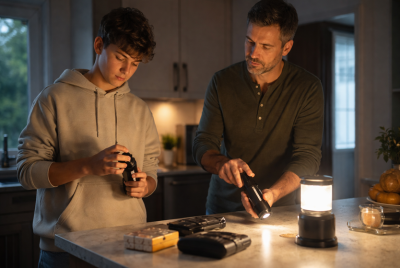
A dark house becomes disorienting faster than many people expect. Practicing how to move safely with flashlights, lanterns, or battery-powered lights helps reduce confusion immediately.
This is not just about owning light sources. It is about knowing where they are, how bright they actually are, how long they last, and how your home feels when overhead lighting is gone. A quick evening practice session can teach you more than a drawer full of unopened gear.
Boiling, heating, and preparing basic food with fewer conveniences
If your normal kitchen routine depends on electricity, takeout, or appliances, even a short disruption can make meals feel harder than they should.
Beginners benefit from practicing simple food preparation with fewer steps, fewer tools, and fewer assumptions. That might mean reheating shelf-stable food, preparing a basic meal from pantry items, or figuring out what your household can realistically eat when routines are interrupted.
The useful skill here is not culinary creativity. It is adaptability.
Finding, carrying, and using water more deliberately
Most people use water constantly without thinking about it. Practicing survival-minded water habits at home helps you understand how quickly needs add up.
This can be as simple as paying attention to how much your household actually uses in a day, handling stored water more intentionally, or thinking through how you would manage if water became temporarily limited or harder to access.
A beginner does not need to become an expert in emergency water systems overnight. But it helps to stop treating water as invisible.
Staying oriented without your usual systems
Many home routines depend on automatic supports: phone batteries, internet access, bright lighting, reminders, apps, and familiar timing. When those disappear, even briefly, people can become more scattered than they expect.
Practicing simple orientation skills at home means learning to function with less friction. That may include memorizing important phone numbers, knowing where key documents are, keeping backup batteries charged, or navigating basic household tasks without depending entirely on your phone.
This kind of readiness is easy to underestimate because it feels ordinary. In practice, it is often what helps a household stay steady.
Organizing supplies so they are usable, not just owned
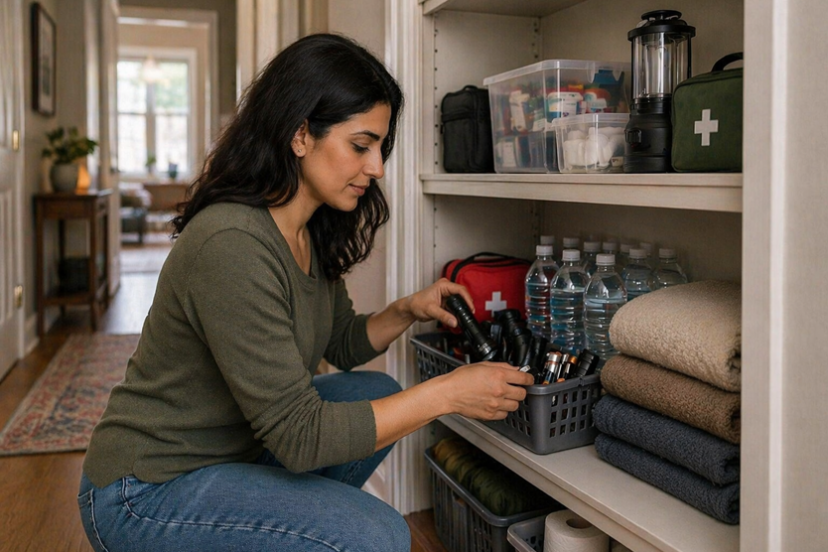
One of the most overlooked beginner survival skills is household organization. A supply is only helpful if you can find it, trust it, and use it when your stress level is higher than normal.
That means knowing where the flashlights are, where extra batteries live, where backup food is stored, where basic first-aid items are, and what needs replacing. In many homes, the problem is not total lack of supplies. It is fragmentation.
Organization is a readiness skill because disorder creates delay, and delay creates stress.
Why these skills matter more than people think
Preparedness is often misunderstood as a gear problem. In reality, many early failures during a disruption come from confusion, hesitation, and lack of familiarity.
A person who has practiced a few ordinary skills in a calm setting is often in a better position than someone who owns more supplies but has never used them. Experience reduces friction. Familiarity lowers mental load. Repetition makes a household more functional when conditions are less convenient.
This matters because most real disruptions are not cinematic. They are inconvenient, tiring, and mentally noisy. The household that can adapt without spiraling has an advantage.
That advantage usually begins with basic practice, not dramatic training.
What beginners often get wrong
A common misunderstanding is assuming survival skills have to be extreme to count. That belief causes many people to delay useful practice because they think they need to camp outdoors, buy specialized gear, or train for worst-case scenarios before they can begin.
Another common mistake is trying to learn too much at once. When beginners treat preparedness like a giant category to conquer, they often end up consuming information without building any real competence. The result is more anxiety, not more readiness.
Some people also focus too heavily on products. Buying tools can support preparedness, but it does not replace familiarity, routine, or decision-making. A flashlight in packaging is not a practiced lighting plan. A camp stove in storage is not confidence with off-grid meal prep. A box of supplies is not the same thing as a household that knows how to function.
The issue is not lack of seriousness. It is misplaced emphasis.
A calmer way to think about survival practice
It helps to reframe survival skills as “disruption skills.” That shift makes the topic feel more grounded and more useful.
You are not preparing for a fantasy version of collapse every time you practice at home. You are building tolerance for interrupted systems. You are teaching yourself and your household how to function when convenience drops and uncertainty rises.
That is a more realistic standard, and for most beginners, it is the right one.
You do not need to become fearless. You do not need to know everything. You just need to become less dependent on perfect conditions.
That is a meaningful form of preparedness.
Start where your household is most fragile
If you are not sure what to practice first, pay attention to the points where your home feels most dependent. That is often where beginner skill-building matters most.
For one household, it may be lighting. For another, food preparation. For another, organization, water awareness, or functioning without a charged phone. The best place to start is usually not the most dramatic weakness. It is the most practical one.
That approach also helps preparedness stay sustainable. When you practice skills that clearly connect to your real life, readiness feels less like a separate identity and more like a useful household capability.
Preparedness grows faster when it feels normal
One reason people avoid practicing survival skills is that they assume the experience has to feel intense. But beginners often learn better when practice feels ordinary.
A quiet hour spent locating supplies, using backup lighting, preparing a simple meal differently, or testing how your household functions with fewer conveniences can teach more than a pile of emergency content ever will.
Normal practice builds confidence because it removes some of the mystery. You stop imagining preparedness as something distant and start recognizing it as a set of manageable adjustments.
That shift matters. A calmer household usually makes better decisions.
The real goal is confidence, not performance
For beginners, survival skills practiced at home are not about impressing anyone. They are about reducing confusion and increasing steadiness.
If you can move through your house safely during a power outage, prepare simple food with fewer assumptions, keep basic supplies organized, and think more clearly when routines break, you are already building useful readiness. That may not look dramatic, but it is often exactly what helps in real-world disruptions.
Preparedness does not have to start big to be real. It can start with noticing what your home depends on, practicing a few useful skills, and becoming a little more capable each time.
That is enough to matter. And for most beginners, it is the right place to begin.

More to Explore