How To Choose An Emergency Weather Radio
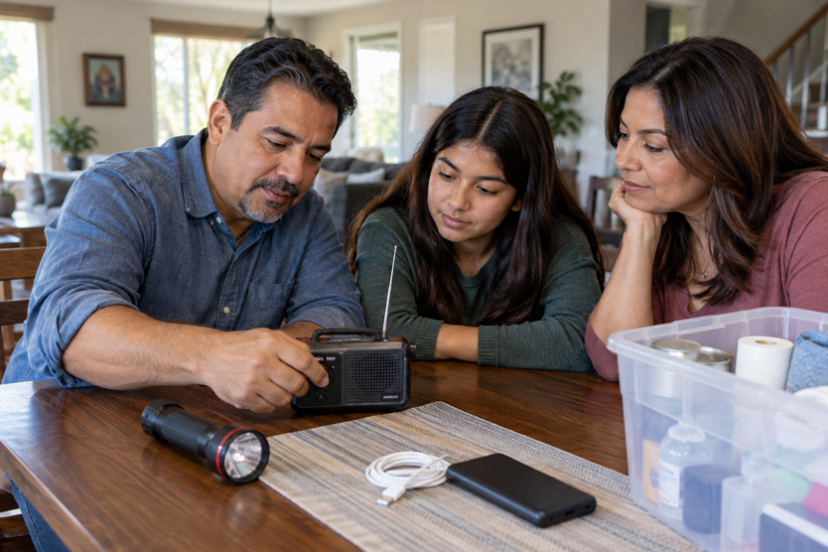
An emergency weather radio can give your household another way to receive important information when power, internet service, or cellular connections are unreliable. But that does not mean every household needs the most feature-packed model—or that every radio marketed for emergencies works the same way.
For most households, the practical goal is simple: choose a radio that can receive NOAA Weather Radio broadcasts where you live, has a power setup you can realistically maintain, and is straightforward enough that someone in the household can operate it when needed.
NOAA Weather Radio All Hazards broadcasts National Weather Service warnings, watches, forecasts, and other hazard information over seven dedicated VHF frequencies. Those broadcasts require a receiver capable of tuning the NOAA weather band; an ordinary AM/FM radio alone cannot receive them.
The right emergency weather radio is therefore less about collecting features and more about deciding which combination of reception, alert capability, backup power, lighting, portability, and ease of use fits your household.
When An Emergency Weather Radio Genuinely Helps
A weather radio can be useful when you want an information source that does not depend entirely on your home internet connection or cellular data.
That can matter during situations such as:
- A local power outage
- Severe thunderstorms or high winds
- Flooding or wildfire-related disruptions
- Winter storms
- Temporary cellular or internet outages
- Evacuations or situations where you need portable information access
NOAA Weather Radio operates continuously through a nationwide transmitter network and carries official weather watches, warnings, forecasts, and other hazard information. Reception depends on your location, terrain, antenna position, and proximity to a transmitter.
A portable radio can also serve ordinary outage needs. AM/FM reception can provide local news, while built-in lighting or limited USB power may reduce the number of separate devices you need to retrieve from storage.
The radio should still be viewed as one communication layer, not as a complete emergency plan. Household alerts, charged phones, flashlights, backup batteries, evacuation information, and a basic family communication plan remain important.
When You May Not Need Another Weather Radio
Buying another emergency radio may add little value if you already own a functioning NOAA-capable receiver with backup power and you routinely maintain it.
Likewise, if your primary goal is simply listening to local news during brief outages, a basic battery-operated AM/FM radio may satisfy that narrower need.
Smartphones can also provide emergency notifications and weather information during normal network operation. The advantage of a dedicated weather radio is redundancy—it gives you another information source rather than replacing the ones you already use.
Before buying, ask what gap you are actually trying to fill.
If your household already has several dependable ways to receive alerts and one maintained NOAA radio, adding another complicated multipurpose device may be less useful than checking batteries, charging existing equipment, or improving how your emergency supplies are organized.
The Most Important Factors When Choosing An Emergency Weather Radio
1. NOAA Weather Reception Versus Automatic Alerting
This is one of the most important distinctions to understand.
A radio that receives the seven NOAA Weather Radio frequencies lets you manually tune in to broadcasts from the National Weather Service. But you should not automatically assume that every NOAA-capable radio can sit silently in standby and activate itself when an alert tone is transmitted.
Some models specifically provide a weather-alert standby mode.
For example, Midland documents a WX Alert mode on the ER310 that monitors for alerts while the radio is in standby. Sangean’s U.S. version of the MMR-99 also provides a weather-alert mode that can sound an alert and then play the selected weather broadcast.
FosPower documents the A6 as receiving all seven NOAA weather frequencies, but its current product documentation emphasizes weather-band reception rather than the type of automatic standby alert operation documented for the Midland and Sangean models.
If automatic warning activation is important to you, verify that functionality specifically rather than relying only on phrases such as “NOAA radio” or “weather radio.”
Also distinguish ordinary weather-alert operation from SAME — Specific Area Message Encoding. SAME-capable receivers can be programmed for specific geographic areas. NOAA notes that SAME functionality requires appropriately equipped receivers.
Do not assume a portable crank radio includes SAME unless the manufacturer explicitly says so.
2. Primary And Backup Power
An emergency radio should be easy to keep ready before an outage begins.
USB charging is generally the most practical way to recharge a built-in battery during ordinary conditions. Hand cranks and small solar panels are better viewed as additional backup options rather than substitutes for keeping the battery charged.
Consider whether the radio can also run from replaceable batteries.
That gives you another option if the internal rechargeable battery is low or aging.
For example, Midland’s ER310 uses a rechargeable lithium-ion battery and can also operate using six AA batteries. Its internal battery can be charged through USB, its solar panel, or the hand crank.
The FosPower A6 combines an internal rechargeable battery with USB-C, solar and hand-crank charging and can also use AA batteries as an alternate power source.
The Sangean MMR-99 uses a 2,600mAh rechargeable lithium battery and provides USB-C, solar, and hand-crank charging.
The most useful configuration is the one your household will actually maintain.
3. Battery Capacity And Device Charging
Many emergency radios include a USB output that can provide some power to another device.
That can be useful, but an emergency radio should not automatically be treated as your household’s primary phone power bank.
Its stored energy may also need to run the radio, display, and lights.
If phone charging is an important part of your outage plan, a separate charged power bank may be a better primary solution, leaving the radio’s battery available for information and lighting.
Among these examples, FosPower specifies a 5,200mAh internal power bank for the A6. Midland currently specifies a 3,500mAh rechargeable battery for the ER310, while Sangean specifies a 2,600mAh rechargeable battery for the MMR-99.
Capacity is useful context, but a larger number does not automatically make a radio the better fit. Consider what you expect the radio itself to do.
4. Controls And Ease Of Use
Emergency equipment has limited value if nobody remembers how to operate it.
Look at how the radio handles:
- Band selection
- Weather-channel tuning
- Weather-alert activation
- Volume
- Flashlight controls
- Charging
- Battery selection
- Antenna positioning
Some radios favor physical switches and tuning controls. Others use digital tuning, displays, presets, and additional modes.
Neither approach is universally better.
A household that wants something stored in a basic emergency bin may favor simplicity. Someone who expects to use the radio regularly may appreciate digital tuning, station memories, Bluetooth, or other convenience features.
Whatever you choose, operate the radio before storing it.
5. Lighting And Other Secondary Functions
A built-in flashlight can be genuinely useful during outages because the radio is already something you may keep within reach.
Some radios also include reading lights, flashing modes, sirens, or signaling features.
These can be helpful, but they should remain secondary to the radio’s core purpose.
The FosPower A6 includes a flashlight and a separate reading light. Midland’s ER310 includes an LED flashlight with an SOS flashing function. The Sangean MMR-99 includes several flashlight modes as well as an emergency light and siren functions.
Do not pay substantially more for secondary features unless they solve a need you actually have.
6. Storage, Durability, And Routine Maintenance
An emergency radio may spend months sitting unused.
That makes maintenance important.
Keep it somewhere accessible rather than buried under rarely used equipment. Periodically charge the internal battery, check replaceable batteries for leakage or expiration, confirm the controls still operate, and verify that you can receive your local NOAA station.
Reception should be tested in the location where you expect to use the radio. NOAA notes that reception varies with terrain, transmitter location, buildings, and atmospheric conditions.
Water resistance may also be worth considering if the radio could be used outdoors.
The Sangean MMR-99 carries an IP55 rating for dust and water resistance. FosPower specifies IPX3 water resistance for the A6.
Those ratings describe different levels of environmental protection and should not be interpreted as permission to submerge the devices.
Three Emergency Weather Radios To Consider
These examples are not ranked. Each represents a somewhat different combination of features and household use.
Midland ER310 Portable Emergency Crank Weather Radio — Model ER310
May be a good fit for:
Households that put straightforward NOAA weather-alert operation and multiple backup power options near the top of the list.
Why it may fit:
Midland documents reception of all seven NOAA weather channels and a weather-alert standby mode. The ER310 uses a 3,500mAh rechargeable lithium-ion battery and can recharge through USB, solar, or hand crank. It also accepts six AA batteries as backup power. Other functions include AM/FM reception, an LED flashlight, USB device charging, a headphone jack, and a backlit display.
Things to consider:
The ER310 still needs routine charging and an occasional reception check. Its primary USB charging connection is Micro-USB rather than USB-C, which may matter if your household is trying to standardize cables. Hand-crank and solar charging should be treated as backup methods rather than reasons to leave the main battery unmaintained.
Sangean MMR-99 AM/FM Bluetooth Weather Emergency Radio — Model MMR-99
May be a good fit for:
Households that want a more full-featured radio they may use outside emergency situations as well.
Why it may fit:
The U.S. MMR-99 supports all seven NOAA weather channels and includes a weather-alert standby function. Sangean also provides AM/FM radio, station presets, Bluetooth audio, USB-C charging, solar and hand-crank charging, a 2,600mAh rechargeable battery, USB output for compatible devices, multiple flashlight modes, and IP55 dust and water resistance.
Things to consider:
This model has more controls and functions than a very basic emergency radio. That can be useful if you expect to use those features, but households wanting the simplest possible device may prefer fewer modes. Its rechargeable battery capacity is also lower on paper than the FosPower A6’s, so consider radio features and alert functionality rather than comparing battery capacity alone.
FosPower NOAA Emergency Weather Radio A6 — Model A6
May be a good fit for:
Households that prioritize battery capacity, several power options, and integrated lighting in one compact outage device.
Why it may fit:
FosPower specifies a 5,200mAh rechargeable battery, all seven NOAA weather frequencies, AM/FM reception, USB-C charging, solar charging, hand-crank charging, and AA-battery operation. The A6 also includes USB device charging, a flashlight, a separate reading light, an SOS alarm, a headphone jack, and IPX3 water resistance.
Things to consider:
The current manufacturer documentation clearly describes access to NOAA emergency weather broadcasts, but it does not document the same dedicated standby weather-alert operation described for the Midland ER310 and Sangean MMR-99. If automatic alert activation is one of your primary reasons for buying a radio, verify that requirement carefully rather than assuming NOAA reception alone provides it.
The larger internal battery may be useful for outages, but using it to charge phones will also reduce the energy available to run the radio and lights.
Common Emergency Weather Radio Buying Mistakes
Buying Mainly For The Hand Crank
A hand crank is useful as an emergency backup, but it is not a replacement for charging the radio beforehand.
It is more realistic to start an outage with a charged radio and use the crank only when necessary.
Assuming Every NOAA Radio Automatically Alerts You
Receiving NOAA broadcasts and automatically activating when an alert is issued are separate capabilities.
If unattended alert monitoring matters to you, look for clearly documented weather-alert standby or SAME functionality.
Choosing Based On Battery Capacity Alone
A larger battery can be useful, particularly if you expect to use integrated lighting or emergency USB charging.
But reception, controls, alert behavior, backup batteries, and ease of maintenance may matter more than capacity alone.
Treating The Radio As A Phone-Charging System
USB output can provide useful supplemental power.
For households that expect extended outages, however, maintaining dedicated power banks may be more practical than relying heavily on the radio’s battery.
Buying A Radio And Never Testing It
Reception varies by location.
Turn the radio on, find your local NOAA channel, learn the controls, and make sure everyone who may need it understands the basics before the radio goes into long-term storage.
A Simpler Or Lower-Cost Approach
Not every household needs a multifunction solar-and-crank radio.
If you already receive dependable emergency alerts through several channels and simply want backup local information during short outages, a basic battery-powered radio may be enough.
If NOAA broadcasts are important, however, make sure the receiver specifically supports the NOAA weather frequencies. A standard AM/FM-only portable radio cannot tune them.
You can also improve readiness without buying anything by reviewing the equipment you already own:
- Charge existing power banks.
- Enable appropriate emergency alerts on household phones.
- Locate your flashlights and spare batteries.
- Test any weather radio you already have.
- Write down important local emergency information.
- Make sure family members know where emergency supplies are stored.
Preparedness improves when useful equipment is maintained and easy to find—not simply when more equipment is purchased.
Final Decision Checklist
Before choosing an emergency weather radio, ask:
- What realistic outage or communication problem am I trying to solve?
- Can the radio receive the NOAA Weather Radio station serving my area?
- Do I want NOAA reception only, or do I specifically need automatic weather-alert standby?
- Do I want replaceable batteries in addition to an internal rechargeable battery?
- Can I easily recharge the radio using cables and power sources I already maintain?
- Will I realistically use phone charging, a reading light, Bluetooth, or other secondary features?
- Are the controls simple enough for other household members to operate?
- Where will I store the radio?
- How often will I recharge and test it?
- Do I already own equipment that solves the same problem?
For many households, the most practical emergency weather radio is not the one with the longest feature list. It is the one that receives the information you need, remains powered through realistic backup options, and is simple enough to keep maintained and ready.